
AKTU FEE Sessional Exam 1: Most Important Questions for DC Circuit & AC Circuit (Unit 1 & 2)
Complete list of most important theory and numerical questions for AKTU FEE Sessional Exam 1 covering Unit 1 DC Circuits and Unit 2 AC Circuits with derivations and problem-solving focus.AKTU FEE Sessional 1 important questions for DC Circuit and AC Circuit units with numericals, derivations and theory for exam preparation.

Important questions
- Defines Ohm’s law with example?
- State & explain Kirchhoff’s law (KVL & KCL) with example?
- Define form factor, peak factor, and average value & RMS value in AC circuit?
- Drive the relation of current across the pure inductor, capacitor, and resistance. Prove that the power consumed across pure inductor & pure capacitor is zero?
- Find average value & RMS value of sinusoidal current (symmetrical wave).
- Calculate the current across 10 Ω resistances by using Maxwell mesh current method
Or loop method? (Practice questions)

- Calculate the voltage and current across 2Ω resistance by using all the known methods (Kirchoff’s law/nodal analysis/mesh method?

- What are apparent power, reactive power, active power and power factor (powerTriangle)? Explain the disadvantages of lower power factor.
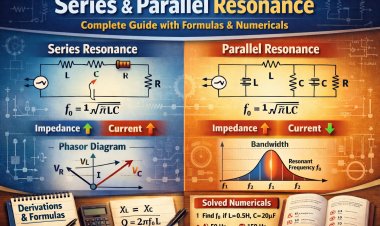
- What is Series resonance? Why it is called voltage resonance. Derive the relation of Resonant frequency.
- Define active, passive, unilateral and bilateral, linear and nonlinear elements.
- Two alternating currents represented by the equations I1=7sinωt and I2=10sin(ωt+π/3) Are fed into a common conductor. Find the equation for the resultant Current and its R.M.S value? Also Form factor and peak Factor.
- Drive the expression for AC circuit containing Capacitor only with phasor diagram?
- What is Resonance curve? Draw the resonance curve for high value of resistance series resonance?
- Define node, junction, branch, loop, mesh?
- Differentiate between Bilateral and Unilateral circuits.
- Three Impedances (6+j5) Ω, (8-j6) Ω, & (8+j10) are connected in parallel. Calculate the current in each branch when the total current is 20 A.



































.svg)